
UV Curing Systems Market Valued at US$ 7.3 Bn in 2026, Projected to Reach US$ 16.6 Bn by 2033 at 12.4% CAGR
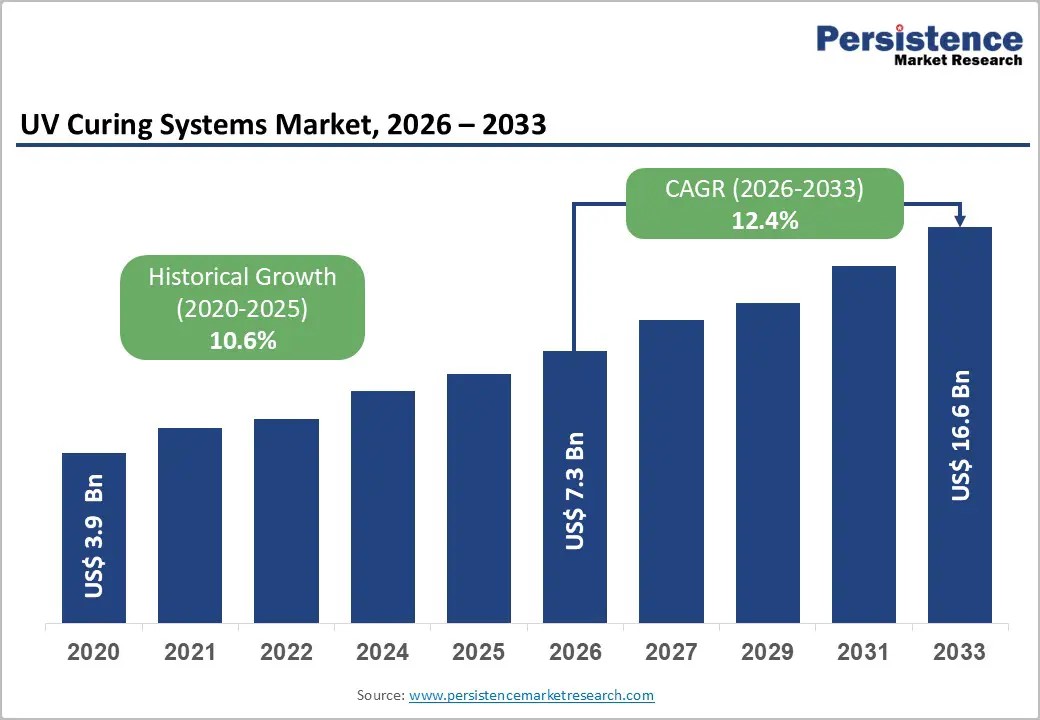
Global UV Curing Systems Market valued at US$ 7.3 Bn in 2026, projected to reach US$ 16.6 Bn by 2033, growing at a CAGR of 12.4% from 2026 to 2033
BRENTFORD, ENGLAND, UNITED KINGDOM, June 29, 2026 /EINPresswire.com/ -- The global UV Curing Systems Market is undergoing a strong structural transformation, driven by rapid industrial modernization, environmental regulations, and the shift toward energy-efficient manufacturing technologies. The market is valued at US$ 7.3 billion in 2026 and is projected to reach US$ 16.6 billion by 2033, expanding at a CAGR of 12.4% during the forecast period. Historically, the market stood at US$ 3.9 billion in 2020, highlighting a sustained long-term growth trajectory supported by electronics expansion, packaging innovation, and industrial automation.
A key growth driver behind this expansion is the accelerated transition from mercury-based UV lamps to UV LED curing systems, which offer 20–50% lower energy consumption, longer operational lifespans, and mercury-free compliance with global environmental regulations. Additionally, stringent VOC emission standards across the EU, North America, and Asia Pacific are pushing manufacturers toward UV-curable coatings and adhesives as cleaner alternatives to solvent-based systems. Asia Pacific leads the market with a 42% share, driven by massive electronics and semiconductor manufacturing ecosystems in China, Japan, South Korea, and India. Meanwhile, the electronics and semiconductor segment dominates end-use demand, accounting for 32% share due to widespread applications in PCB fabrication, display manufacturing, and advanced chip packaging.
𝐆𝐞𝐭 𝐚 𝐒𝐚𝐦𝐩𝐥𝐞 𝐏𝐃𝐅 𝐁𝐫𝐨𝐜𝐡𝐮𝐫𝐞 𝐨𝐟 𝐭𝐡𝐞 𝐑𝐞𝐩𝐨𝐫𝐭: https://www.persistencemarketresearch.com/samples/36712
Market Segmentation
The UV Curing Systems Market is segmented by technology, system type, and end-use industry. By technology, it includes UV LED and mercury lamp systems. UV LED dominates due to higher energy efficiency, mercury-free operation, and precise curing, while mercury lamps are declining due to regulatory pressure and higher energy use.
By system type, the market includes conveyor/inline, spot, and flood curing systems. Conveyor/inline systems lead due to their use in high-speed production lines, while spot curing is the fastest-growing segment, driven by precision applications in electronics and medical devices.
By end-use industry, the market covers electronics & semiconductors, industrial manufacturing, automotive, aerospace & defense, healthcare, and packaging. Electronics & semiconductors lead due to heavy use in PCB and chip manufacturing, while industrial manufacturing is growing fastest as UV curing replaces traditional thermal and solvent-based processes.
Regional Insights
Asia Pacific leads the market with 42% share, driven by strong electronics manufacturing in China, Japan, South Korea, and India’s expanding semiconductor ecosystem supported by PLI schemes. North America holds 28% share, supported by semiconductor growth under the CHIPS Act and strong aerospace demand. Europe accounts for 23% share, driven by strict environmental regulations like RoHS and WEEE, pushing rapid adoption of UV LED systems.
𝐃𝐨 𝐘𝐨𝐮 𝐇𝐚𝐯𝐞 𝐀𝐧𝐲 𝐐𝐮𝐞𝐫𝐲 𝐎𝐫 𝐒𝐩𝐞𝐜𝐢𝐟𝐢𝐜 𝐑𝐞𝐪𝐮𝐢𝐫𝐞𝐦𝐞𝐧𝐭? 𝐑𝐞𝐪𝐮𝐞𝐬𝐭 𝐂𝐮𝐬𝐭𝐨𝐦𝐢𝐳𝐚𝐭𝐢𝐨𝐧 𝐨𝐟 𝐑𝐞𝐩𝐨𝐫𝐭: https://www.persistencemarketresearch.com/request-customization/36712
Market Drivers
One of the strongest drivers of the UV Curing Systems Market is the rapid global shift toward UV LED technology adoption. UV LED systems offer lower energy consumption, longer lifespan, and environmentally safe mercury-free operation, making them highly attractive to manufacturers aiming to reduce operating costs and comply with tightening environmental regulations. These systems also provide precise wavelength control, enabling superior curing quality in sensitive applications such as semiconductor packaging and medical device manufacturing. Additionally, increasing demand for high-speed production in electronics, automotive, and packaging industries is accelerating the need for efficient curing solutions that reduce cycle times and improve throughput.
Another major driver is the expansion of the global electronics and semiconductor industry. Rising semiconductor demand driven by AI, 5G infrastructure, automotive electronics, and advanced computing is significantly increasing the use of UV curing systems across multiple production stages. Similarly, the shift toward electric vehicles is creating new applications in battery assembly, power electronics, and sensor encapsulation, further strengthening market demand.
Market Restraints
Despite strong growth, the market faces challenges related to high initial capital investment and integration complexity. UV LED curing systems require significantly higher upfront costs compared to conventional mercury lamp systems, which can deter adoption among small and medium-sized manufacturers, particularly in emerging markets. Additionally, integration into existing production lines often requires process redesign, photoinitiator reformulation, and technical expertise, increasing overall implementation costs and extending payback periods.
Another restraint is the supply chain dependency on a limited number of specialized component suppliers, particularly for UV LED chips and high-performance optical materials. Concentration of manufacturing capabilities in regions such as Japan, South Korea, and Germany creates potential vulnerabilities to geopolitical disruptions, logistics delays, and pricing volatility, impacting system availability and production scalability.
Market Opportunities
Significant opportunities exist in high-value sectors such as aerospace, defense, automotive electrification, and advanced industrial manufacturing. Aerospace and defense applications require precision bonding, composite assembly, and conformal coating, where UV curing offers superior performance due to its non-thermal, high-accuracy curing capabilities. The global defense sector’s expanding R&D and production activities are expected to drive long-term adoption of advanced UV systems.
Another major opportunity lies in the electric vehicle (EV) ecosystem. EV manufacturing introduces new UV curing applications in battery packs, power electronics, and lightweight composite structures. As global EV adoption accelerates, UV curing systems are becoming critical for ensuring durability, thermal stability, and high-performance bonding in next-generation automotive platforms. Additionally, industrial expansion in emerging markets such as India, Vietnam, and Indonesia is creating new manufacturing hubs, opening substantial opportunities for UV curing system suppliers.
𝐁𝐮𝐲 𝐍𝐨𝐰 𝐭𝐡𝐞 𝐃𝐞𝐭𝐚𝐢𝐥𝐞𝐝 𝐑𝐞𝐩𝐨𝐫𝐭: https://www.persistencemarketresearch.com/checkout/36712
Company Insights
• Excelitas Technologies Corp.
• Nordson Corporation
• IST Metz GmbH and Co. KG
• GEW (EC) Limited
• Dymax Corporation
• Dr. Hönle AG (Honle UV America, Inc.)
• Miltec UV Corporation
• Phoseon Technology, Inc.
• American Ultraviolet Corporation
• Panacol-Elosol GmbH
• Baldwin Technology Company Inc.
• Heraeus Noblelight GmbH
• Panasonic Holdings Corporation
• UVitron International, Inc.
Conclusion
The UV Curing Systems Market is undergoing strong growth, driven by sustainability regulations, automation, and semiconductor expansion. The shift from mercury lamps to UV LED technology is reshaping cost structures and improving efficiency across industries. Rising demand from electronics, automotive, aerospace, and industrial manufacturing is further boosting adoption. With ongoing technological advancements, the market is expected to maintain strong double-digit growth through 2033 and become a key part of advanced smart manufacturing systems.
Related Reports:
Identity Analytics Market
RFID Electronic Toll Collection System Market
Pooja Gawai
Persistence Market Research
+1 646-878-6329
email us here
Visit us on social media:
LinkedIn
Instagram
Facebook
YouTube
X
Legal Disclaimer:
EIN Presswire provides this news content "as is" without warranty of any kind. We do not accept any responsibility or liability for the accuracy, content, images, videos, licenses, completeness, legality, or reliability of the information contained in this article. If you have any complaints or copyright issues related to this article, kindly contact the author above.
